

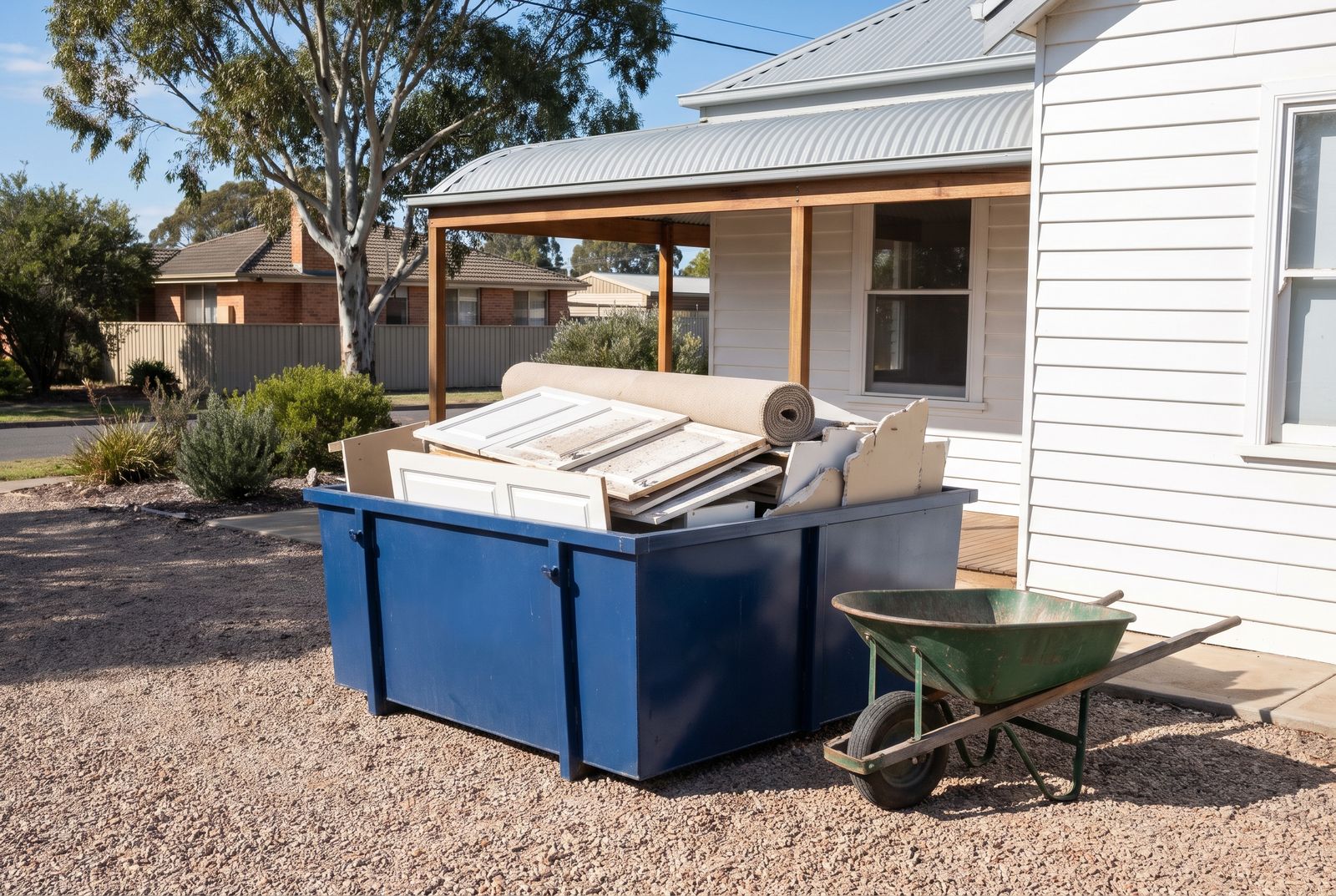
What size skip?
Skips are sized in cubic metres. Pick the job or measure the pile to find yours.
Choose what is going in, then pick the job or type in the size of the pile. You get the bin size, what it roughly holds and an estimated price range. Nothing is sent.
- Sizes for household, garden and heavy loads
- The common sizes drawn to scale
- An estimated price range for each size
The tool
Find the skip bin size for your job
Pick what is going in, then pick the job or measure the pile. The answer shows straight away.
Pick what is going in, then a job or the size of your pile, and the bin size shows here.
Skip bin sizes
The common skip bin sizes, drawn to scale
Skips are sized in cubic metres. The drawings are to scale with each other by volume.
2 cubic metres
8 to 14 wheelie bins
Estimated $180 to $450
3 cubic metres
12 to 21 wheelie bins
Estimated $270 to $500
4 cubic metres
16 to 28 wheelie bins
Estimated $280 to $600
6 cubic metres
24 to 42 wheelie bins
Estimated $380 to $900
9 cubic metres
36 to 63 wheelie bins
Estimated $480 to $1,300
A wheelie bin means a standard 240 litre household bin. Loose rubbish takes up more room than the same things did in place. If you are between two sizes, the bigger bin is usually cheaper than a second delivery.
Size by job
What size skip bin for which job
These are the usual sizes for common jobs. If you are between sizes, go up one.
| Job | What is going in | Usual size |
|---|---|---|
| A single room clear-out | Household rubbish | 2 to 3 cubic metres |
| A kitchen renovation | Household rubbish | 4 to 6 cubic metres |
| A garage or shed | Household rubbish | 4 to 8 cubic metres |
| A whole house | Household rubbish | 6 to 12 cubic metres |
| A hedge trim or a small backyard tidy-up | Garden and green waste | 2 to 3 cubic metres |
| A full seasonal garden clean-out | Garden and green waste | 4 to 6 cubic metres |
| A major clear-out or storm clean-up | Garden and green waste | 8 cubic metres or more |
A single room clear-out usually fits 2 to 3 cubic metres, a kitchen renovation 4 to 6, a garage or shed 4 to 8 and a whole house 6 to 12. A 2 to 3 cubic metre skip usually suits a hedge trim or a small backyard tidy-up, 4 to 6 cubic metres a full seasonal garden clean-out, and 8 cubic metres or more a major clear-out or storm clean-up.
Size and price
Estimated skip bin prices by size
These are estimates of what to expect for each size, as ranges. Every business sets its own price.
| Skip size | Roughly holds | Estimated price |
|---|---|---|
| 2 cubic metres | 8 to 14 wheelie bins | $180 to $450 |
| 3 cubic metres | 12 to 21 wheelie bins | $270 to $500 |
| 4 cubic metres | 16 to 28 wheelie bins | $280 to $600 |
| 6 cubic metres | 24 to 42 wheelie bins | $380 to $900 |
| 9 cubic metres | 36 to 63 wheelie bins | $480 to $1,300 |
Estimates only, for a general household bin on a standard hire of up to a week, with delivery, pick-up and tipping up to the weight limit. A wheelie bin means a standard 240 litre household bin. The ranges overlap because businesses price each size differently. Every business sets its own price.
| Skip size | Suits | Estimated price |
|---|---|---|
| 2 to 2.5 cubic metres | A hedge trim or small garden tidy-up | $180 to $300 |
| 3 to 3.5 cubic metres | A small to medium garden clean-up | $230 to $380 |
| 4 cubic metres | A medium garden clean-up | $270 to $580 |
| 6 cubic metres | A large garden clean-up | $350 to $640 |
| 9 cubic metres | A big landscaping job or storm clean-up | $440 to $950 |
Estimates only, for a skip of garden waste only on a standard hire of up to a week, with delivery, pick-up and tipping up to the weight limit. The two smallest rows each cover two bin sizes, because businesses stock different sizes. The ranges overlap because businesses price each size differently. Every business sets its own price.
Measuring
How to measure a pile of rubbish for a skip bin
Measure the length, width and height of the pile in metres and multiply the three. A pile 2 metres long, 1.5 metres wide and 1 metre high is 3 cubic metres.
Loose rubbish takes up more room than the same things did in place. If you are between two sizes, the bigger bin is usually cheaper than a second delivery.
Fill the bin level with the rim and no higher. A skip filled above the rim cannot be covered and carried safely, so most drivers will not take it.
Heavy loads
What size skip bin for bricks, concrete and soil
Bricks, concrete, tiles, soil and rubble need a heavy bin. As an estimate, a 2 cubic metre heavy bin is $250 to $460. Heavy loads are often limited to the smaller bins.
A general bin usually has a weight limit, and most companies do not allow soil, concrete, bricks or tiles in it. A clean load of only concrete or bricks can cost less than general rubbish.
Weight
What a full skip bin weighs, by what is in it
Volume is only half of it. A small bin of bricks weighs far more than a big bin of branches. These weights use the Queensland Government default figures for turning cubic metres of waste into tonnes.
| What is in the bin | Tonnes a cubic metre | A full 2 cubic metre bin, about | A full 4 cubic metre bin, about | A full 6 cubic metre bin, about |
|---|---|---|---|---|
| Garden and green waste | 0.15 | 300 kilograms | 600 kilograms | 900 kilograms |
| Timber and wood | 0.19 | 380 kilograms | 760 kilograms | 1.14 tonnes |
| Mixed building waste | 0.7 | 1.4 tonnes | 2.8 tonnes | 4.2 tonnes |
| Bricks | 1.2 | 2.4 tonnes | 4.8 tonnes | 7.2 tonnes |
| Soil, sand and clean fill | 1.3 | 2.6 tonnes | 5.2 tonnes | 7.8 tonnes |
| Concrete | 1.5 | 3 tonnes | 6 tonnes | 9 tonnes |
The figures are published as a general guide for waste site operators, so your load can weigh more or less. Each weight is the figure times the bin size. Source: Queensland Government, Volumetric surveys: converting volume to weight. Read on 13 November 2026.
Questions
Skip bin sizes: your questions answered
Straight answers on sizes, weight and filling the bin.
What if I am between two skip sizes?
Go up one. Loose rubbish takes up more room than the same things did in place. If you are between two sizes, the bigger bin is usually cheaper than a second delivery.
Do I need a skip at all?
Not always. For a few big items, your council hard rubbish collection or the tip may be all you need, and neither involves us. The council, tip, skip or crew tool works it out in three questions.
Is there a weight limit?
General bins usually have one, and it varies by business. Published limits run from 300 kilograms for a 2 cubic metre bin to between 1.35 and 2 tonnes for a 9 cubic metre bin. Weight over the limit is charged, usually at $270 to $480 a tonne for general rubbish. Bricks, concrete, soil and tiles are the usual cause, so book a heavy bin for those.
How full can I fill the skip?
Level with the rim and no higher. A skip filled above the rim cannot be covered and carried safely, so most drivers will not take it. You may be asked to take the extra off, pay for the labour to unload it, or hire a second bin.
What is the difference between a mini skip and a walk-in bin?
A mini skip is the smallest size, usually 2 cubic metres, though some businesses use the name for bins up to 4. You lift rubbish over the side. A walk-in bin has a door at one end, so you can walk or wheelbarrow loads straight in. Some businesses fit a door as standard on larger bins, and others charge about $10 to $50 more for one.
Is a skip bag or a rubbish removal crew better for a small job?
It can be. A skip bag holds about 1 to 3 cubic metres and costs roughly $150 to $400 with collection, and you can fill it over weeks. A rubbish removal crew loads for you, and for jobs under about 4 cubic metres it often costs about the same as a skip or less. A skip suits rubbish that builds up over several days, or more than about 4 cubic metres.
Will the truck fit, and will the skip mark my driveway?
Skip trucks need about 3 metres of width and 4 to 5 metres of height, clear of power lines, trees and carports. Mention a steep or narrow driveway when you book. A loaded skip is heavy, so lay timber boards or old ply under it on pavers, thin concrete or a decorative surface.
Official sources
Every rule on this page comes from one of these pages, read on the date shown beside the rule. This page was checked on 14 November 2026. Rules change, so check the page before you act on one.
- Queensland Government, Volumetric surveys: converting volume to weight
Ready for a skip bin?
Tell us what is going in it. A local skip business gets back to you within the hour.